
The $2 Billion Wildlife Tax: Aviation’s Growing Territorial War

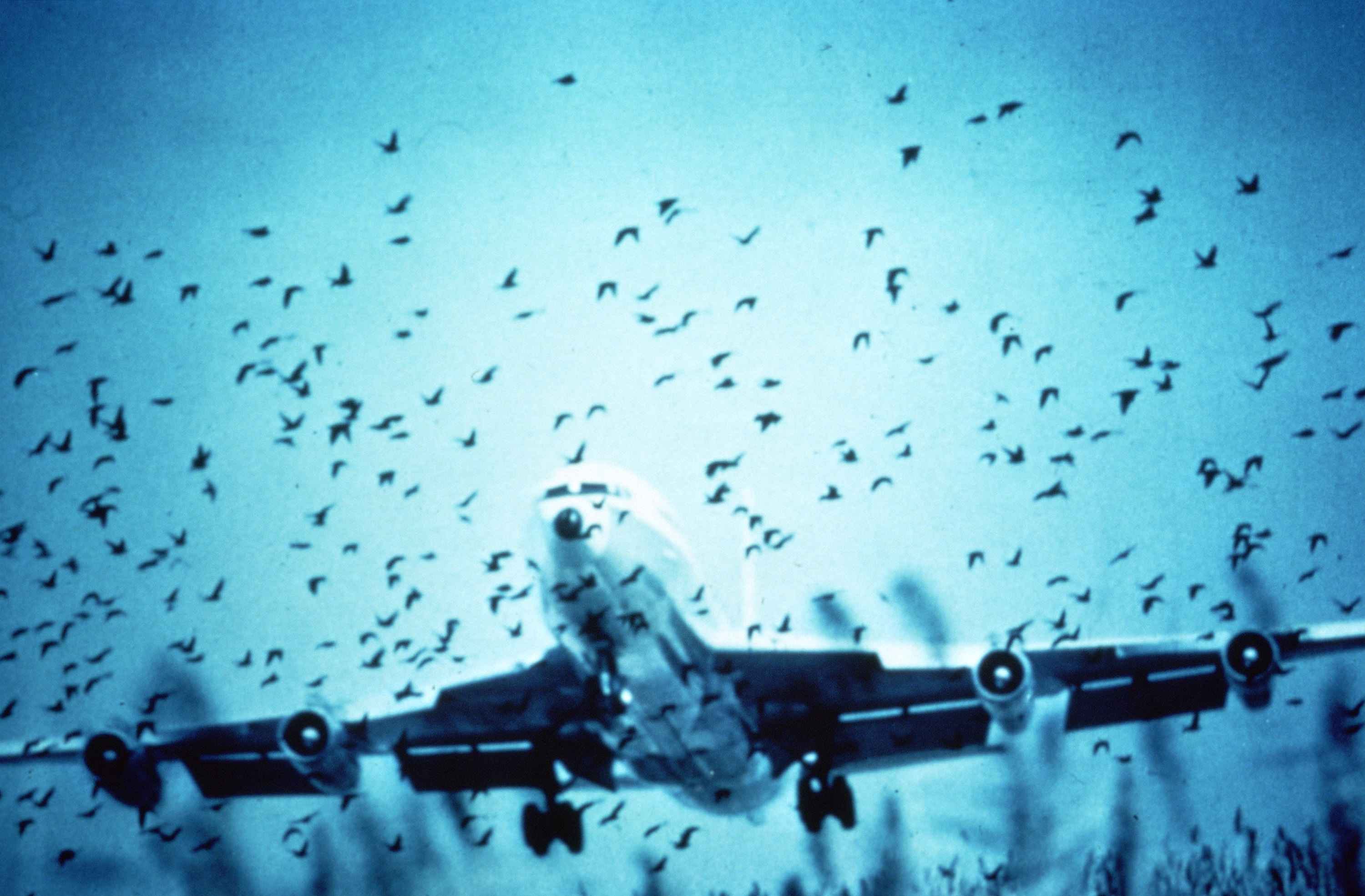
It remains one of the most astonishing events in aviation history. On January 15, 2009, Captain Chesley “Sully” Sullenberger and First Officer Jeffrey Skiles took off from LaGuardia. Almost immediately, their US Airways Airbus A320 plowed into a flock of Canada geese, knocking out both engines. Their subsequent landing on the Hudson River—the “Miracle on the Hudson”—is a triumph that will be told for generations.
But the story that hasn’t been told is darker than the miracle. Despite a century of countermeasures — falconry programs, habitat modification, pyrotechnics, radar, trained sharpshooters — the collision rate is not falling. It is rising. The Hudson wasn’t a fluke. Given the mathematics of modern aviation, it was almost inevitable.
What’s genuinely remarkable is that it doesn’t happen every month.
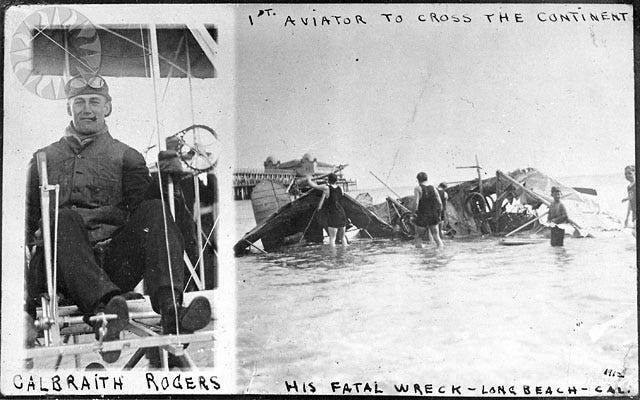
It’s a conflict as old as aviation itself, beginning on September 7, 1905, when Orville Wright collided with a bird while circling a cornfield near Dayton, Ohio. The first recorded fatality followed in April 1912, when a gull flew into the rigging of a Wright Flyer off Long Beach, California, sending pilot Cal Rodgers crashing into the ocean.
As aircraft multiplied, grew larger, and flew faster, bird strikes expanded exponentially. On October 4, 1960, an Eastern Air Lines Lockheed Electra struck a flock of starlings after departing Boston Logan. The aircraft crashed into Winthrop Bay, killing 62 of the 72 people on board.
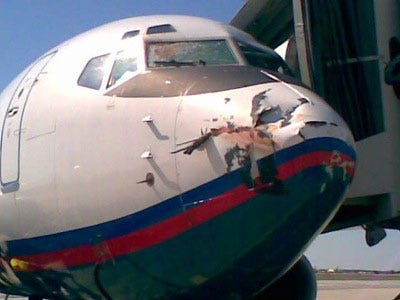
Today, there are roughly 22,000 bird strikes in the U.S. alone and there is rarely a week when a commercial aircraft does not suffer from bird strikes. As I prepared this article, I looked back at bird strikes reported by Aviation Herald just in March 2026:
March 9: United Boeing 737 cracked windshield, pressurization problems from bird strike. Newark.
March 12: Delta Boeing 717 engine damage from bird strike, St. Louis
March 13: Peace Boeing 777 cracked windshield from suspected bird strike, near Abuja.
March 13: JAL Boeing 737 Damage to nose section from bird strike climbing out of Misawa.
March 19: Wizz Air Malta Airbus A320 bird strike at Cluj
March 21: China Southern Airbus A330 multiple bird strikes climbing out of Shanghai Hongqiao caused entire radome to separate.
March 29: Edelweiss Airbus A320 rejected takeoff due to suspected bird strikes at Zurich.
The Hidden 14% Spike
According to a joint report by the FAA and the US Department of Agriculture, wildlife collisions have quietly evolved from an operational nuisance into a major safety and financial threat.
“Globally, wildlife strikes with civil and military aircraft combined have killed more than 643 people and destroyed over 360 aircraft from 1990-2024. Specific to the USA, wildlife strikes have killed 82 people and destroyed 126 aircraft in that same period.”[1]
The trend line is accelerating. In 2024, while U.S. commercial airport traffic ticked up by a modest 4%, bird strikes surged by 14%, resulting in 22,372 reported incidents in the U.S. alone. General aviation airports are seeing similar spikes.
Where the Danger Lies: 75 percent of bird strikes occur at or below 10,000 feet, but the danger has no ceiling. Geese have been observed flying at 32,000 feet. The record for a bird strike was when an aircraft struck a Ruppell’s vulture at 37,000 feet above the Côte d’Ivoire coast.
The financial toll is staggering. When an Air France Concorde ingested a flock of gulls on approach to New York’s JFK, it cost the airline $6 million to get the supersonic jet back into the air. Today, a single significant bird ingestion can easily clear $1 million—and that doesn’t account for the brutal cost of aircraft downtime.
Cumulatively, bird strikes now cost commercial airlines and the military an estimated $2 billion annually.
Read the Full Aviation Briefing for $10/mo
Wildlife mitigation is no longer a localized airport operations duty—it is a core pillar of asset protection and financial risk mitigation. Unlock the data-driven frameworks below.
Upgrade to paid for the deep-dive data and strategic insights that help you stay ahead in the cockpit and the boardroom. Upgrade to the full executive experience for $10/month—or lock in a full year of industry intelligence for $100 and save 17%
Why Do So Many Strikes Occur Near Airports?
The short answer: Airlines and birds both love the same real estate.
Birds are drawn to water, and many of the world’s premier hubs—JFK, SFO, LAX, PHL, DCA, and BOS—sit directly alongside oceans, rivers, or lakes. Furthermore, the massive asphalt expanses of airport runways radiate heat faster than surrounding woods, creating thermal updrafts birds love. Combined with manicured grasslands that offer perfect feeding and breeding grounds, airports look less like concrete jungles and more like five-star avian resorts.
Because total eradication is impossible, the industry has turned to sophisticated mitigation:
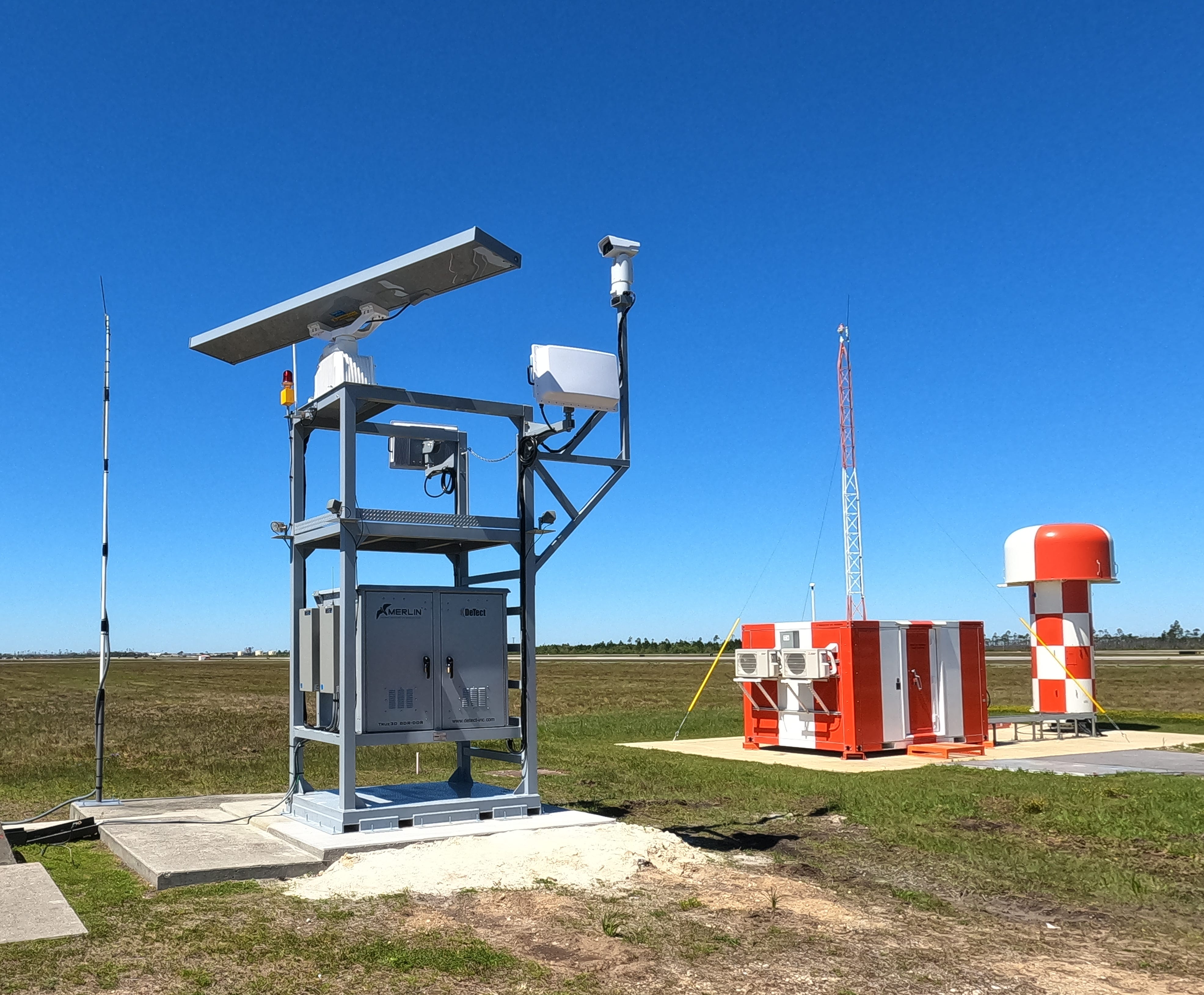
Avian Radar: Systems like DeTect’s MERLIN can track bird activity from the surface up to cruise altitudes up to eight miles out, feeding real-time tracking data directly to Air Traffic Control.
Acoustic & Visual Deterrents: Airfields deploy an arsenal of non-lethal weapons, including recorded bird distress calls, propane cannons, flashing lights, netting, and targeted lasers.
The “Goldilocks” Grass Strategy: Seattle-Tacoma International (SEA) discovered that mowing airfield grass too short allows small birds to easily spot worms and insects. Conversely, letting it grow past 14 inches creates ideal nesting grounds for larger predators like owls. SEA now meticulously maintains its grass at an optimal, inhospitable height, while actively managing wildlife risks across a five-mile radius outside the airport perimeter.
Blinded by the Night
It is a dangerous misconception that bird strikes are strictly a daytime, low-altitude hazard. Birds fly at night, and they fly high.
On January 8, 2003, a Horizon Air DHC-8-401Q sustained severe structural damage near Medford, Oregon, during a night flight. A multiple bird strike shattered the left windscreen, temporarily incapacitating the captain. (The co-pilot successfully landed the aircraft).
Similarly, a Southwest 737-300 climbing through 14,000 feet after a night departure from New Orleans plowed into a flock of teals, causing catastrophic damage to its radome, wing, and fuselage.
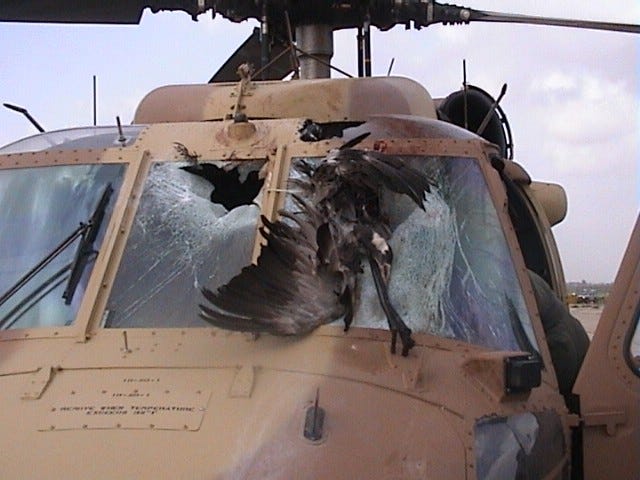
The hazard crosses all sectors of aviation. Even military operations are highly vulnerable; an Israeli Air Force Blackhawk helicopter was severely damaged after striking a migrating crane at 800 feet AGL during a low-altitude exercise.
Winning the Battles, Losing the War
And yet, for all the ingenuity and investment, the data tells a stubborn story.
Bird populations are rebounding. The Migratory Bird Treaty Act and decades of conservation have done exactly what they were designed to do. Canada goose populations in the northeastern U.S. have grown dramatically since the 1970s. The birds that hit Flight 1549 were likely resident geese — year-round urban birds, not migratory visitors — a population that barely existed fifty years ago. Conservation success and aviation safety are pulling in opposite directions, and nobody in either camp wants to say so publicly.
Quieter engines are deadlier for birds. The high-bypass turbofan engines that make modern jets so fuel-efficient also make them nearly silent on approach. Earlier generations of turbojet aircraft gave birds a fighting chance to scatter. Today’s engines do not. The aircraft that can’t be heard is the aircraft that can’t be avoided.
The numbers. The FAA wildlife strike database shows reported strikes climbing from roughly 1,800 annually in 1990 to over 22,000 by 2024. Even accounting for improved reporting, the trajectory is unambiguous. More flights, more birds, more overlap.
The Final Verdict: A Strategic Imperative
Ultimately, bird strikes can no longer be dismissed as mere “acts of God” or an unavoidable cost of doing business. In a hyper-efficient aviation ecosystem where capacity is razor-thin and aerospace supply chains are severely choked, a single flock of geese possesses the economic power to disrupt an entire airline network.
The aviation industry has spent a century engineering marvels capable of defying gravity, but we have reached a physical ceiling. We cannot build an engine tough enough to withstand every impact, nor—as we transition to quieter, more sustainable turbofans—can we build an aircraft loud enough to warn nature away. As the skies grow more crowded and aircraft become quieter, this territorial battle for airspace will only intensify.
Airline executives must stop viewing wildlife mitigation as a niche, localized airport operations duty. It must be treated as a core pillar of asset protection, capacity management, and financial risk mitigation. We may share the skies with nature, but it is the airlines that must strategically engineer the peace.
The real miracle of US Airways Flight 1549 isn’t that two pilots saved 155 lives on a freezing January afternoon. It’s that an entire invisible infrastructure of wildlife biologists, airport operations managers, ornithologists, and FAA statisticians has held the line well enough that we’ve only had one Hudson.
So far.
[1] “Wildlife Strikes to Civil Aircraft in the United States 1990 – 2024,” Joint report by the FAA and US Department of Agriculture
Join the Conversation
For our premium subscribers: How is your airline or airport authority balancing environmental conservation with bird strike mitigation? Are landing fees doing enough to fund advanced solutions like real-time avian radar? Let us know your thoughts in the comments below.