
The Yield of Selling a Dollar for Ninety Cents: The Strategic Autopsy of Spirit Airlines

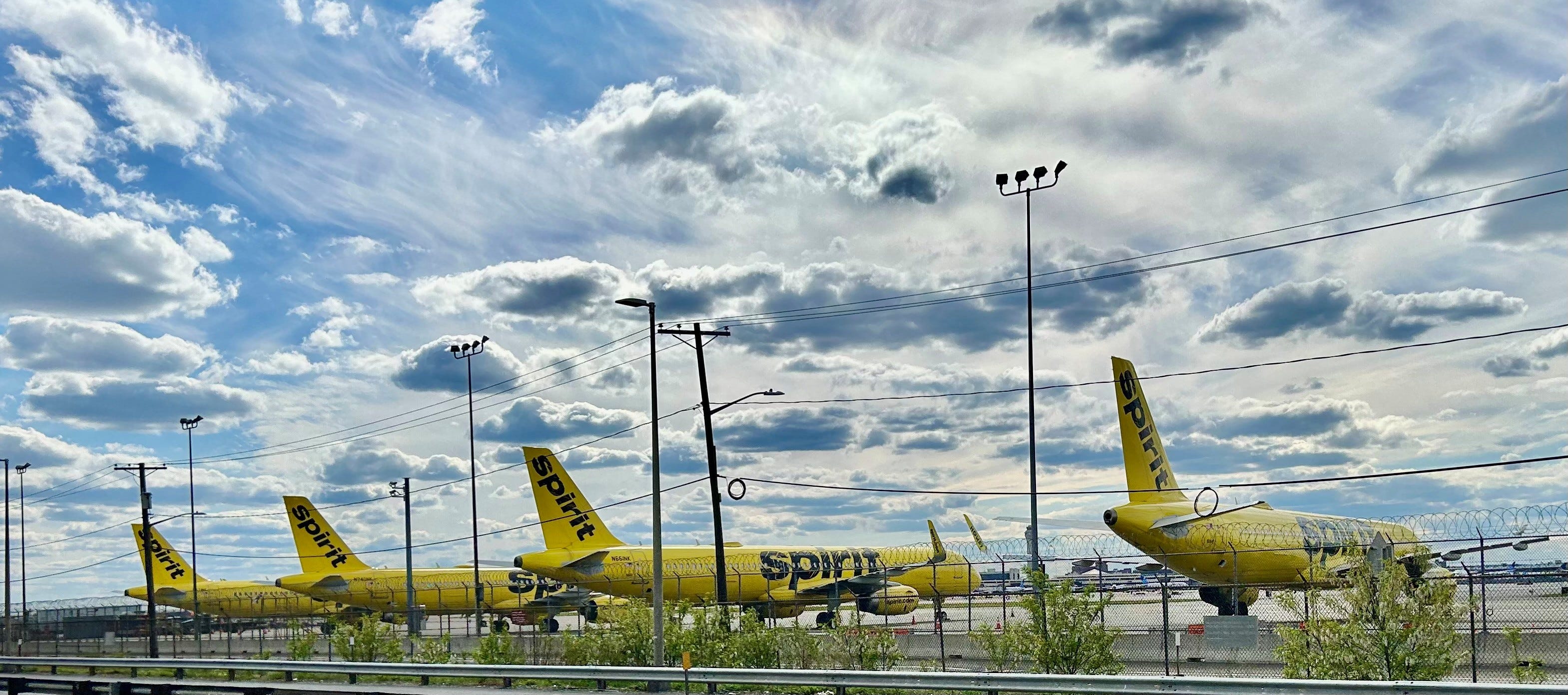
First published in World Airline Strategy Substack May 2, 2026
As I drove up the New Jersey Turnpike toward Newark Liberty International this morning, the overhead electronic signs—usually reserved for mundane traffic alerts or accident warnings—bore a stark, glowing epitaph: “ALL SPIRIT AIRLINES FLIGHTS CANCELLED.”
For the aviation industry, it was the “Yellow Sunset.”
The warning lights had been flashing for a long time, and the airline’s collapse looks less like a sudden shock than the final stage of a business model that had lost too many points of support.
To understand why Spirit failed while others survived, one must look past the flashy yellow livery and into a disastrous cocktail of technical misfortune, strategic rigidity, and a fundamental misunderstanding of “volume.”
The Parable of the Ninety-Cent Dollar
There is an old industry joke about a man on a street corner selling one-dollar bills for ninety cents. A crowd forms around the block. His accountant, horrified, rushes up and screams, “You’re losing ten cents on every transaction! You can’t sustain this!” The man looks at the line and smiles: “Don’t worry, I’ll make it up in volume.”
For the last twenty-four months, Spirit Airlines was that man on the corner.
Why Spirit failed
Two days ago, a colleague told me he had just returned from a trip to Miami from Atlantic City. The fare? $25 each way.
In a 2026 economy where jet fuel prices have spiked to over $4.50 per gallon due to the escalating conflict in Iran, that $25 doesn’t even cover the fuel burn for a single passenger’s seat-share on a 1,000-mile flight, let alone the pilot’s salary, the landing fees at MIA, or the maintenance on the airframe and engines.
Spirit was selling a product for less than the cost of its raw materials. While the “Ultra-Low-Cost Carrier” (ULCC) model once relied on ancillary fees (bags, seats, and snacks) to bridge that gap, the math finally broke. In 2025, Spirit’s average ancillary revenue per passenger plateaued at $70, while their operating cost per passenger soared past $115. No amount of “volume” can fix a $20 hole in every seat.
Spirit’s collapse should not be reduced to a single cause. The airline was hit by the long tail of pandemic-era disruption, a failed merger process, repeated restructuring, weak cash generation, and then another severe spike in jet fuel prices tied to broader geopolitical tensions. Each of those pressures mattered on its own; together, they produced a situation in which the airline’s balance sheet and operating model no longer gave it enough room to recover.
What makes Spirit especially important is that it was not merely a discount airline. It was the purest expression in the U.S. market of the ultra-low-cost idea: very low base fares, high ancillary monetization, and relentless cost discipline.
Spirit did not fail because customers stopped liking cheap tickets; it failed because it could no longer make cheap tickets pay for the rest of the operation. That is the real distinction.
Yellow Bird Over and Out
Spirit Flight NK1833 from Detroit (DTW) to Dallas/Fort Worth (DFW) touched down at 12:09am CDT on Saturday, May 2nd. At one point, it was the #1 most-tracked flight in the world on Flightradar24 as aviation enthusiasts watched the “Yellow Bird” era come to an end. It is officially recorded as the final flight in the airline’s 34-year history.
The GTF Crisis: A Technical Anchor
To be fair to Spirit’s management, not every wound was self-inflicted. The airline was the primary victim of the Pratt & Whitney Geared Turbofan (GTF) engine crisis.
Beginning in 2024, microscopic contaminants in the powdered metal used for high-pressure turbine disks forced the grounding of a significant portion of the global A320neo fleet. Spirit, which had staked its entire growth strategy on the efficiency of these “Fit Fleet” aircraft, was hit hardest.
At one point in late 2025, Spirit had over 45 aircraft grounded—nearly a quarter of its fleet—waiting for engine inspections and parts that were backlogged by months.
It was a double-whammy: Spirit was forced to continue paying debt service on these grounded, high-tech assets while simultaneously wet-leasing older, fuel-hungry aircraft to cover their schedule.
The groundings led to a surge in cancellations, destroying consumer confidence. Once an airline loses the “trust” of the business traveler or the time-sensitive vacationer, it is forced to rely exclusively on the “lowest of the low” fare seeker—the $25 passenger who has zero brand loyalty.
The Bondholder Revolt: Why Liquidation Over Life Support
By April 2026, Spirit was out of runway.
The Trump Administration’s $500 million rescue package reportedly would have given the government warrants or equity representing roughly 90% of Spirit Airlines. This would have placed the government ahead of other creditors in the recovery stack. That structure was always going to be controversial, because it would have diluted or subordinated bondholders who believed they were already sitting on the more senior part of the claim structure.
The only thing that matters is that by midnight on Friday night, the end became inevitable.
The primary architects of today’s shutdown were not the executives, but the bondholders (led by major institutional creditors like PIMCO and Ares). To an outsider, it seems counterintuitive: Why would a creditor want the airline to stop flying?
The answer lies in Asset Residual Value. Spirit’s fleet of A320neo and A321neo aircraft remains one of the most desirable assets in the world. So do the slots it controls at some of the nation’s busiest airports. With Boeing still struggling with delivery delays and the global pilot shortage limiting new capacity, a “used” A321neo is worth more on the open market today than at any point in history.
Bondholders realized that if Spirit continued to fly, the airline would “burn” its remaining cash—and potentially encumber the aircraft with more debt—just to stay operational. By forcing a liquidation, the bondholders can seize the “collateral” (the planes and the engines) and sell them to hungry buyers like United, Delta, or even Middle Eastern carriers. In a liquidation, bondholders might recover 65 cents on the dollar. In a prolonged “Chapter 22” struggle, they might have recovered nothing.
For shareholders, the result is total wipeout. In the hierarchy of bankruptcy, the equity is the “absorber of first loss.” As of this morning, Spirit stock is effectively a souvenir.
A Tale of Two ULCCs: The Frontier Pivot
For years, Spirit and Frontier were twins. However, in 2024, Frontier management—notably CEO Jimmy Dempsey—recognized that the “Pure ULCC” model was a dinosaur. They saw that the American traveler was willing to pay for a “semi-premium” experience if it meant avoiding the “indignity” of the traditional cattle car budget cabin.
Frontier’s “Value Pivot” included:
Up Front Plus: Frontier introduced a “Premium Lite” product—the first two rows of the aircraft with guaranteed empty middle seats and extra legroom.
Fleet Flexibility: While Spirit took every plane Airbus sent them, Frontier deferred 69 orders and returned 24 leased aircraft in early 2026 to “right-size” for the high-fuel environment.
The “Works” Bundle: Frontier successfully migrated their customer base away from $25 “unbundled” fares toward $150 “all-in” bundles that included bags and flexibility.
Frontier realized that you cannot survive by being the “cheapest” when costs are no longer “low.” Spirit stayed in the ninety-cents-for-a-dollar business; Frontier started selling “Value” for $1.10.
The Labor Market: A Silver Lining
The most tragic part of today’s news is the 17,000 employees currently in limbo. However, from an analytical standpoint, some of these employees are entering the strongest “seller’s market” for aviation labor in history.
The US Pilot Shortage, exacerbated by the mandatory retirement of the “Baby Boomer” generation and the slow training pipeline, has left legacy carriers desperate for typed-rated crews.
Preferential Hiring: Within hours of the shutdown, Delta and American Airlines opened expedited application windows for Spirit pilots and A&P mechanics.
The Regional Vacuum: Carriers like SkyWest and Envoy, who have been grounded by a lack of captains, will likely absorb Spirit’s First Officers almost immediately.
Mechanics are also in short supply, as are experienced ground service workers, and airlines should welcome them with open arms
Flight attendants and airport customer service workers may have a much more difficult time finding similar positions in others airlines, and it seems clear that Spirit’s demise will add to the worsening unemployment numbers in the coming months.
While the loss of seniority and the “yellow culture” is a blow to the workforce, the industry’s structural labor deficit ensures that few of these professionals will be unemployed by the end of the month.
The Aftermath: Who Inherits the Kingdom?
The removal of Spirit’s capacity from the market is a massive “gift” to the remaining players.
The Big Three (Delta, United, American): They can now raise fares on “leisure” routes where Spirit’s $25 fares previously forced them to discount their “Basic Economy” product.
JetBlue: Having been blocked from a merger in 2024, JetBlue now gets to pick through Spirit’s gate holdings in Fort Lauderdale and Orlando. Within hours the yesterday’s announcement that Spirit was shutting down, JetBlue announced 11 new routes—all from its large hub at FLL, and all previously served by Spirit. It is a “merger by liquidation,” achieving the same footprint without the debt.
Conclusion
Spirit became a meme. Fodder for late-night comedians.
Spirit Airlines didn’t fail because people stopped flying. It failed because it became an airline run by an algorithm that forgot to account for the price of fuel and the value of a middle seat. It tried to make up for a broken margin with a volume of business it could no longer afford to serve.
While they leaned into being the “no-frills” option, they failed to account for the rise of “Premium Leisure” travel. When the likes of American, Delta and United fought back with “Basic Economy” fares that were marketed as offering no-frills tickets but on a nice big airline with multiple frequencies and global networks, the “Spirit brand” became a liability they couldn’t afford to fix. Travelers became more willing to pay $30 extra for a Legacy carrier’s “Basic Economy” to avoid the perceived unreliability of Spirit.
That $30 premium bought something Spirit could never offer: a seat in a loyalty ecosystem. The Basic Economy passenger on Delta or United was still earning miles toward a seat in business class to Frankfurt or a week in Maui. The Spirit passenger was earning nothing — no points, no status, no path to anywhere. For the “Premium Leisure” traveler who flies cheaply domestically precisely to fund aspirational travel, that asymmetry was decisive.
The legacy carriers also held a structural advantage Spirit could never replicate. High-yield transatlantic and transpacific routes — where a single business class seat can generate more revenue than a dozen Spirit fares combined — gave the Big Three the financial headroom to price domestic Basic Economy fares at marginally profitable or even breakeven levels indefinitely. Spirit had no such cross-subsidy. Every route had to justify itself on its own numbers. When fuel spiked, there was no Frankfurt to bail out Fort Lauderdale.
The signs on the New Jersey Turnpike were more than a traffic alert; they were a signal that the era of the “unconditionally cheap” flight is over. For those of us in airline management, the lesson is clear: If you sell your product for ninety cents, eventually, you run out of dollars.