
Riding the Pacific Puddle Jumper

The news is awash today with stories of new long-haul flights: Sydney-London, Singapore-New York, Auckland-Buenos Aires to name but three.
But long before these globe-spanning services were possible, there was one 16-hour aviation marathon that skipped its way across tiny Pacific atolls that was—and is—unlike any other flight in the world.
Welcome to the Island Hopper.
By any account, a 5:30AM check-in is no fun, even if it is in Honolulu. Today, the line at United’s counter moves quickly, and the checked baggage looks like everybody has a story: TVs, a computer, a new bicycle, a boxed set of cookware. Forty-five minutes later, passengers are invited to board United flight 154, bound—ultimately—for Guam.
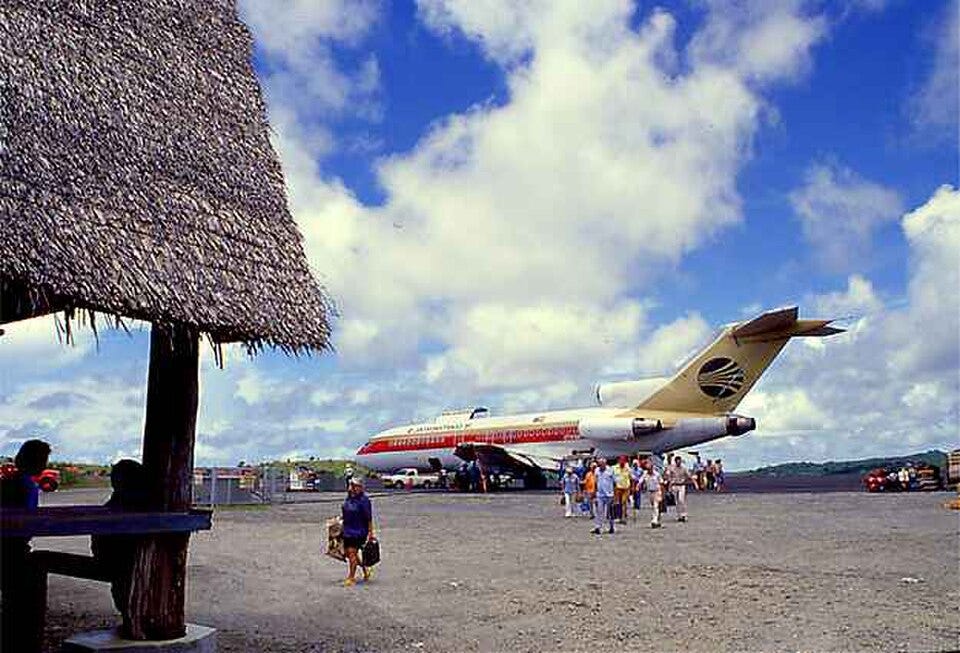
In 1968, Continental’s then-CEO Robert Six launched Air Micronesia and believed the company could do well with a flight that provided the only air service to remote Pacific islands. After all, he reasoned, those islanders needed an easy way to export their fruit and fish and import goods that were only available in major cities. And they needed to travel for university studies, to visit relatives, and to obtain medical care not available on the islands.
“Air Mike,” as it became affectionately known dedicated two Boeing 727s to fly three times weekly Honolulu-Johnston Atoll-Majuro-Kwajalein-Kosrae-Pohnpei-Chuuk-Guam. The aircraft carried overwater survival gear and were modified with special tires and a Teflon coating on the belly to protect the underside of the fuselage from flying stones and coral from the unpaved runway surfaces.
Despite the limited traffic, the Island Hopper was a financial success from the start and at one point the Island Hopper accounted for 30% of Air Micronesia’s business.
Air Micronesia was subsequently rebranded Continental Micronesia, and then in 2010, when United absorbed Continental Airlines, the “Micronesia” brand disappeared and the route was operated as a United Airlines flight. Even today, United exacts a significant premium for the Island Hopper. For a HNL-GUM flight a month in advance, United’s website shows the cheapest one-way fare to be $1,662 on the daily nonstop UA201. But the cheapest fare on UA154—the Island Hopper—is $2,669.
United now uses Boeing 737-800s on the route and says it will replace these with the 737 MAX8 by the end of 2026. Because of the length of the flight with its multiple stops, it carries five flight attendants instead of the four required by law, and has double flight crews. Two pilots typically fly the first (longest) sector and then the other two take over for the remainder of the flight. Since there are no repair facilities at any of the stops, there are multiple spare parts in the hold and a mechanic is on every flight.
The passengers on my flight were an eclectic bunch that included military and Space Command personnel returning to Kwajalein from leave, two university students going home, scuba divers heading for an underwater adventure, and a family of Pacific Islanders returning from heart surgery in Hawaii—the closest hospital to their home a thousand miles away.
We took off into the soft blue morning sky and banked west over Diamond Head, settling on a southwest heading where we would see nothing but ocean for the next four and a half hours. For years, the Island Hopper’s first stop on the westbound route was Johnston Atoll, a minute lump of rock on which the US Government buried tons of nuclear and chemical weapons waste, but the facility is now closed. As we began our descent into Majuro, I spotted a tiny speck, and United 154 began a circling approach to an atoll that resembled a giant “C,” barely above the surface of the water.
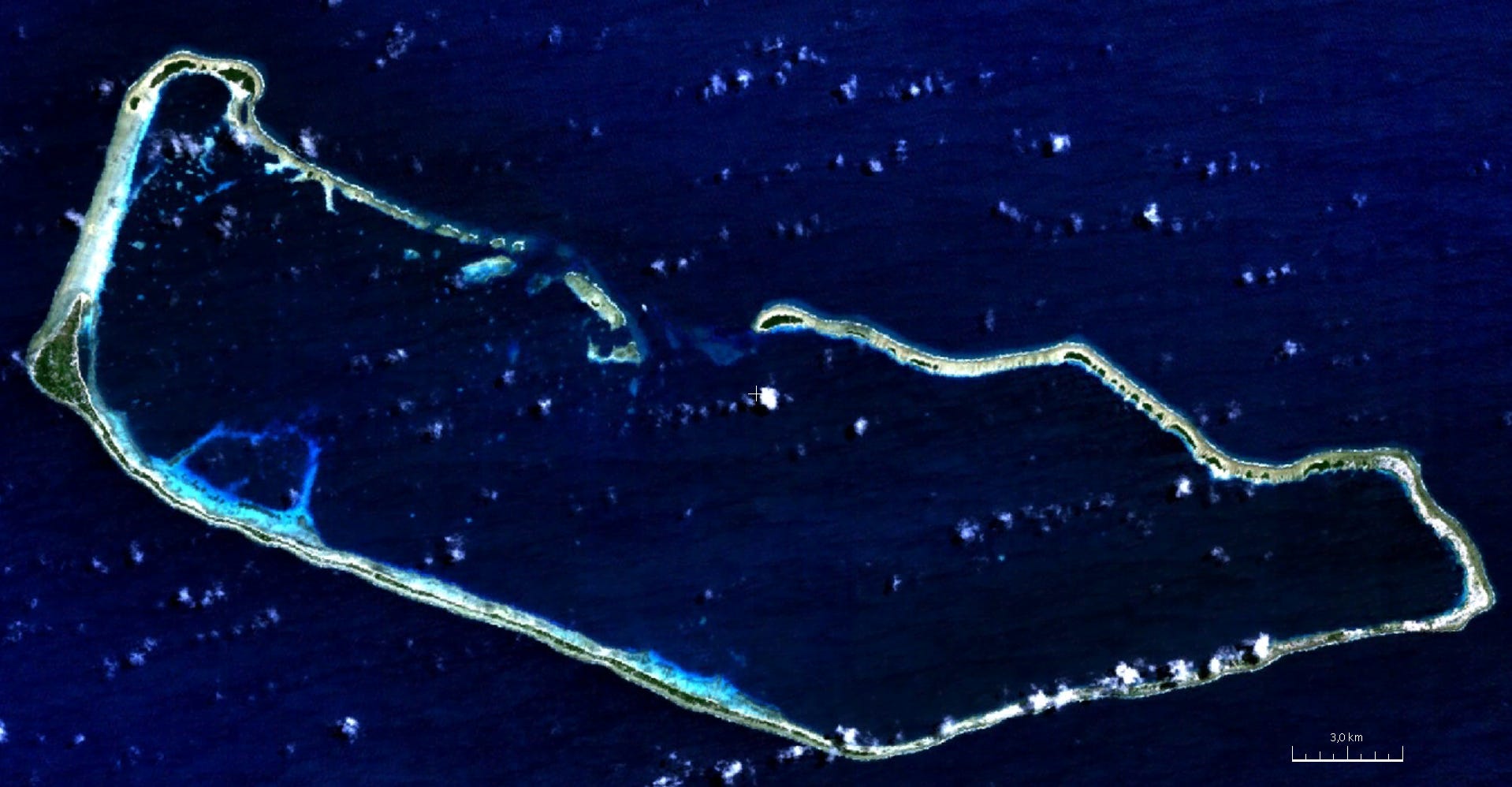
Roughly a third of the passengers disembarked, walking across the ramp past a rusting fire truck that looked as if it had not moved in years. After barely 35 minutes on the ground, the 737 lifted off, affording a spectacular view of the 57 tiny islets in this capital of the Marshall Islands. Each of them little dots of green encircled by necklaces of golden sand.
Crossing the Date Line
A few minutes later, we crossed the International Date Line. In the flight deck, MAZZA intersection marks the exact spot where the navigation system rolls over from 179°59W to 180°00E.
Welcome to tomorrow!
Kwaj: The Catcher’s Mitt (Kwajalein)
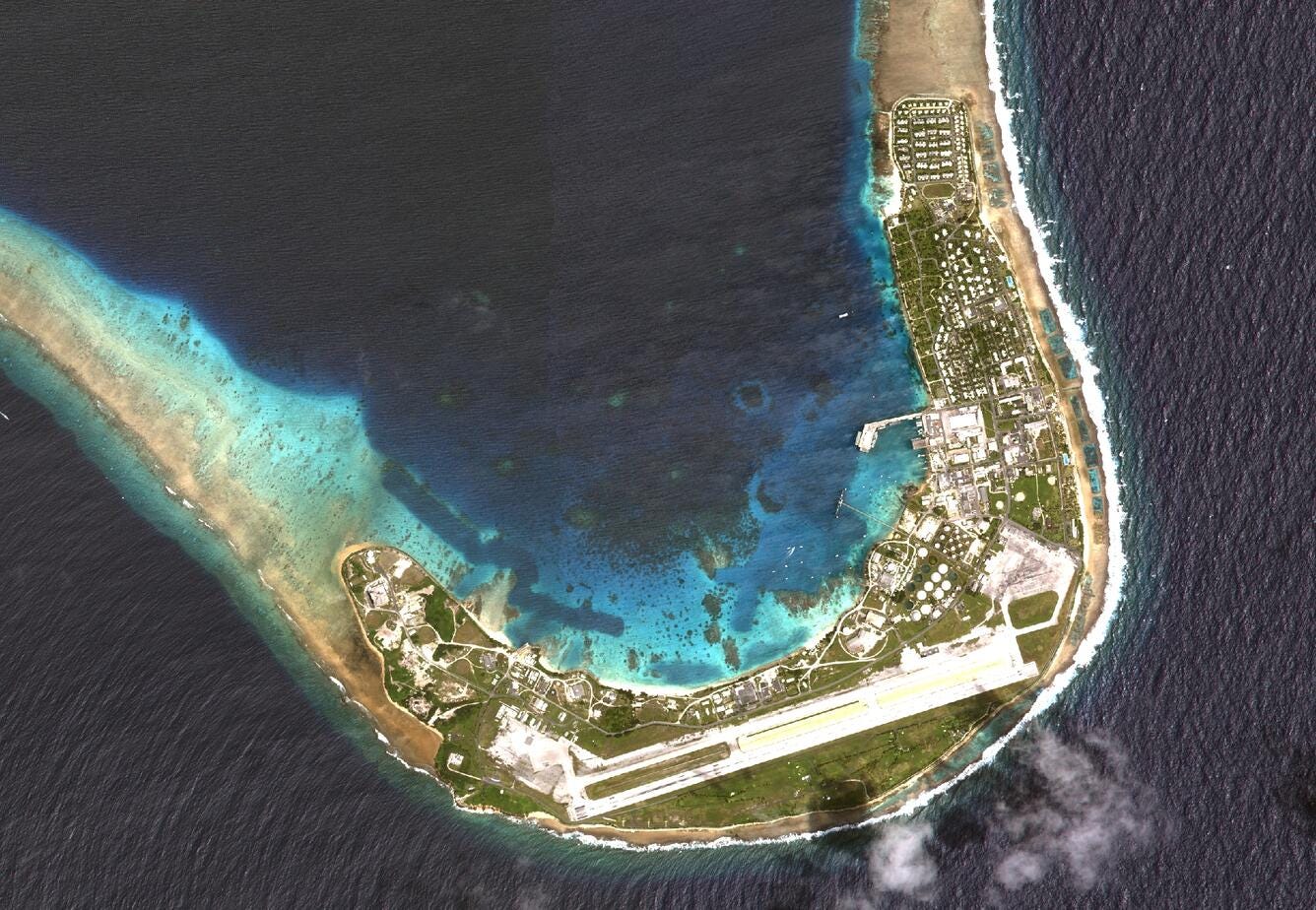
Forty minutes later the captain announced the beginning of our descent into Kwajalein Atoll—with a warning. “Kwaj” houses a U.S. Army base on the airport and is a sensitive military installation. He announced that all window shades must be lowered and kept closed until after takeoff. There could be absolutely no photography, and while we were allowed to stand at the top of the aircraft steps during our ground stops at the other locations, that was not permitted here.
My seatmate was returning from leave in California and he explained that the U.S both launches missile from Kwajalein and also “catches” them when ICBMs are test fired from California’s Vandenburg Air Force Base and tracked across the Pacific. “We call Kwaj ‘The catcher’s mitt’ because it is both shaped like one and also because those missiles from Vandenburg splash into the huge lagoon here.”
As the steps are rolled up to the aircraft door, armed troops board. Only military or authorized government workers are permitted to disembark at Kwajalein, and the eight leaving us today patiently wait in the aisle as each one shows his military ID and is checked to verify that his name is on the list of people expected to be on this flight.
