
The Long Flight Home: The Crew That Left for Auckland and Came Home the Long Way Round

Captain Robert Ford rested his hands lightly on the controls of the California Clipper and gazed out through the broad windows of the flight deck as the first light of December 7, 1941 painted the Pacific in shades of copper and rose.
Twelve thousand feet below, a handful of tiny atolls drifted past — scattered coral jewels trailing white surf along their edges, their lagoons glowing an impossible turquoise against the vast, breathing blue of the ocean.
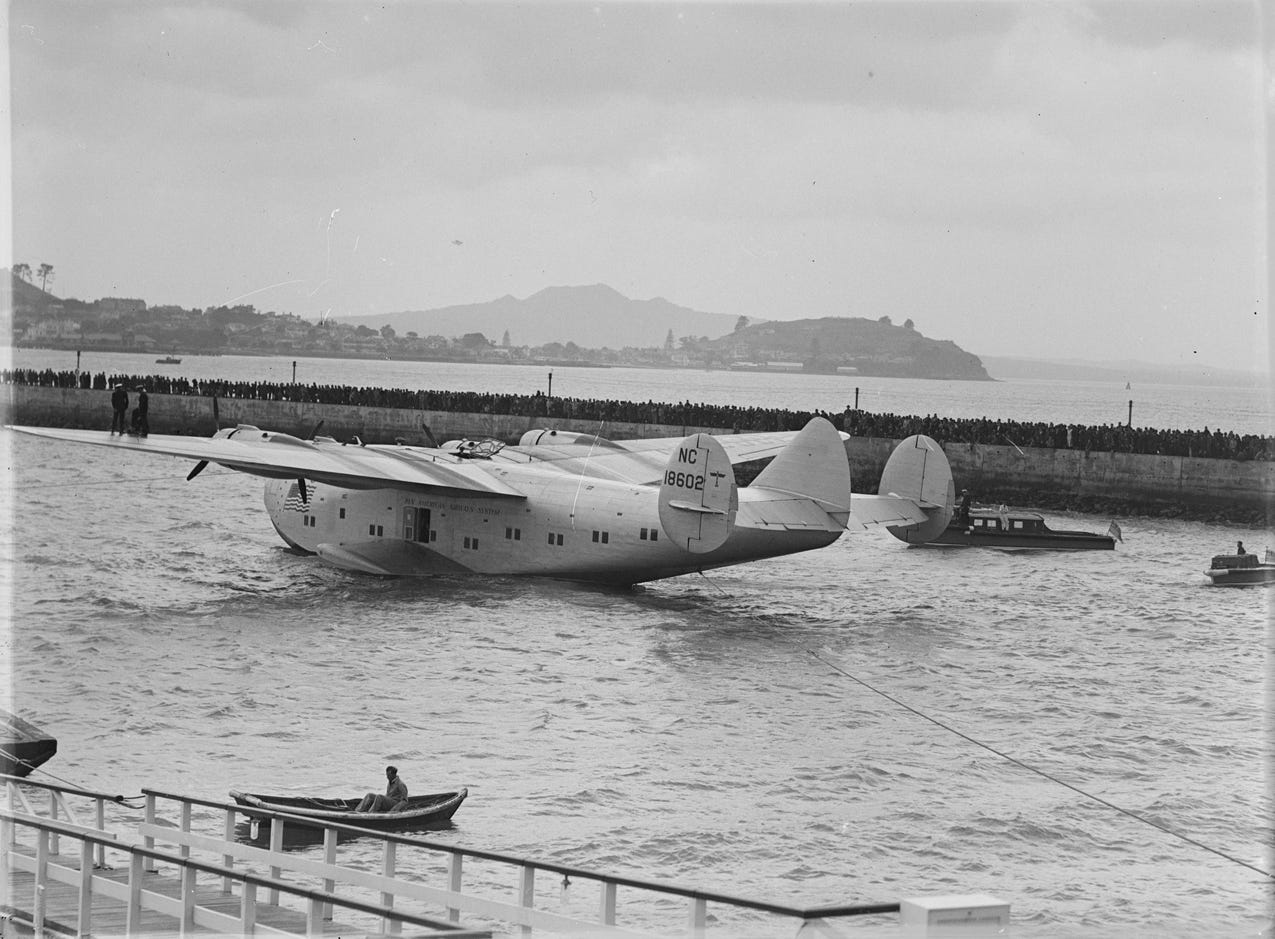
Ford had flown this route a dozen times, yet it never grew ordinary. The Boeing 314, registered as NC 18602, was the finest flying boat Pan American Airways had ever put in the air, a great whale-shaped titan of aluminum and glass, and up here in the early morning quiet she seemed almost alive beneath his hands — steady, powerful, utterly at home above the sea.
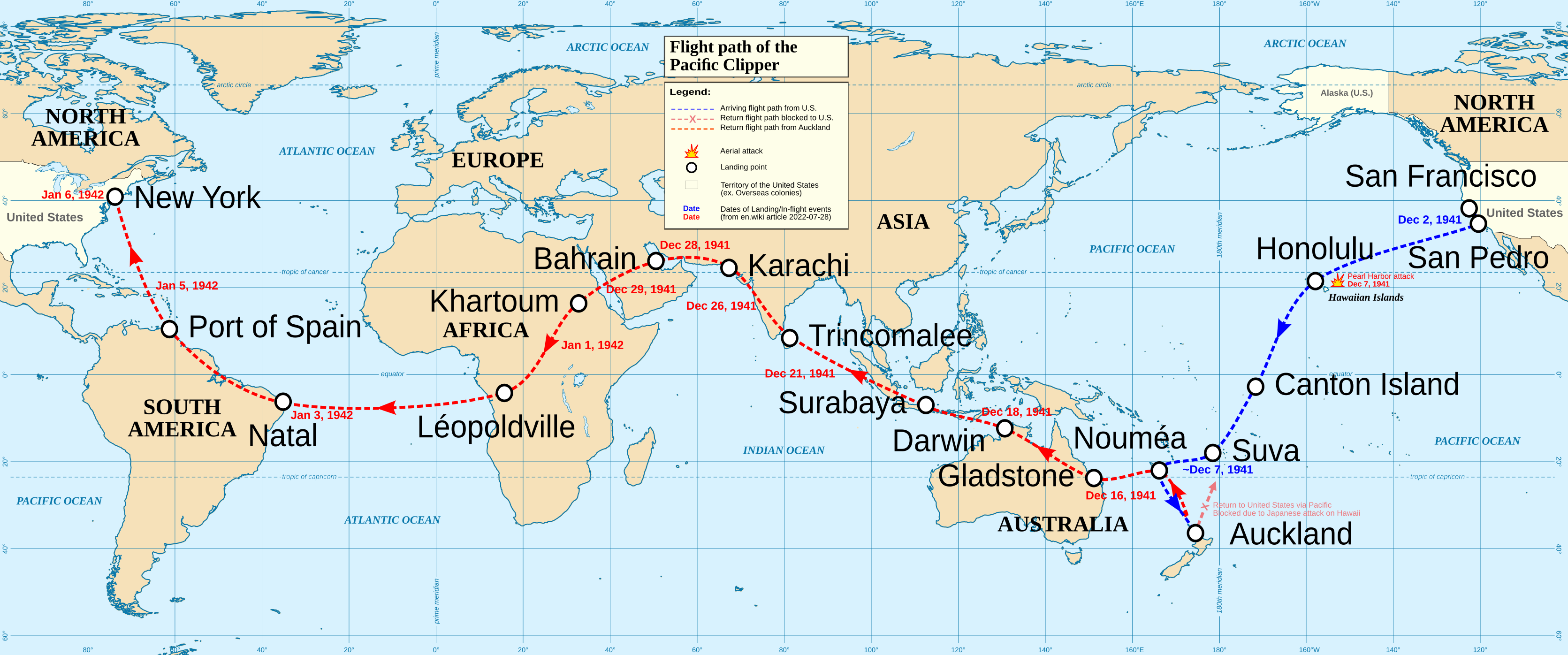
Ford had lifted off from Pan American’s seaplane base at San Francisco Bay’s Treasure Island six days earlier, banking over the Golden Gate bridge before heading to San Pedro and Honolulu. The flight then headed to New Zealand with stops in Canton Island, Suva, and Nouméa, New Caledonia. He would retrace his steps next week and should be home just in time for Christmas.
He looked down at the instrument panel. All was good. Their final destination—a spectacular approach and landing in Auckland’s harbor—was just hours ahead
The twelve passengers in the luxurious cabin behind him were still asleep, lulled by the deep, rhythmic pulse of four Wright Cyclone engines. His crew of ten was calm and professional. They would soon be laying crisp white tablecloths on the dining room tables and preparing cooked-to-order breakfast for the passengers who had paid the equivalent of $12,000 in today’s money for the trip.
The sky ahead was clear. Could there possibly be a better way to earn a living?
Then he heard the footsteps entering the flight deck behind him.
Message From the Radio Room
Radio Officer John Poindexter moved forward with the deliberate, careful walk of a man carrying something he doesn’t want to drop. Ford glanced back and felt the satisfaction drain out of him instantly. He had been reading faces in cockpits for twenty years, and the face coming toward him now — pale beneath the tan, jaw set, eyes wide with something between disbelief and dread — was not the face of a man bringing routine traffic. Poindexter held out the decoded message without a word.
Pearl Harbor was burning. The Japanese had just launched a devastating attack.
Ford ordered Poindexter to radio Pan Am’s base in Nouméa for confirmation.
Was this the truth? Or an awful rumor?
A few minutes later, Poindexter returned to the cockpit with confirmation that Pearl Harbor had been attacked. Naval ships were sunk or burning. The airport was out of action. He said they given him a cryptic message: “Tell Captain Ford to Implement Plan A.”
Pan American’s leaders and the U.S. military had made contingencies in case the United States were to enter the war that had been going on for two years in Europe. It had issued sealed orders to every captain—to be opened only if the U.S. went to war or a Pan American base was attacked.
Ford reached inside his flight bag and retrieved the large brown sealed envelope marked “Plan A.”
The instructions were unambiguous: the California Clipper was a strategic military asset, and it was not to fall into enemy hands under any circumstances. Even before President Roosevelt declared war the next day, Ford knew that such an audacious attack on Hawaii would probably mean his country would soon be at war, and this meant every Pan American aircraft would be requisitioned as a military asset.
He ordered radio silence.
The Boeing 314 had a clear, raised, dome-shaped bubble, typically located on top of the fuselage above the wing, designed to allow the navigator to use a sextant for shooting stars and sun sights to determine the aircraft’s position. Ford ordered a lookout to be stationed there, and two hours later touched down on the grey waters of Auckland harbor. What none of the crew yet understood was that they would not see home again for thirty-one days — and that they would have to circle the entire globe to get there.
Waiting for Orders.
Ford spent much of the next week in the communications room at the American Embassy in Auckland, pacing its worn floors and willing the radio to bring them orders. The route home through the Pacific had ceased to exist. Japanese forces had struck Wake Island, Manila, and Hong Kong in the hours following Pearl Harbor, effectively slamming shut the ocean highway the Clippers had always traveled.
When word finally came from Pan American headquarters in New York, the orders were terse and remarkable in equal measure: return to the La Guardia flying boat base in New York by flying westward. They were ordered to load two spare engines stored in Auckland and carry as spares. The crew was to remove all markings identifying it as a Pan American aircraft.
They were left to plan their own route across 30,000 miles of a world at war in radio silence, scrounge their needed fuel and supplies, and navigate over oceans and continents none of them had ever crossed. They had no charts for most of what lay ahead.
They were, in every practical sense, on their own.
No charts. No radio. No way home except forward. The rest of this story — 30,000 miles of it — is for paid subscribers. Subscribe now to read it, and to get my weekly airline industry stories before anyone else.
