
The Original Disrupter: When Freddie Laker Declared War on the Airline Giants
Before Southwest and Ryanair, one man declared war on a government-backed cartel to give transatlantic flight to the rest of us.

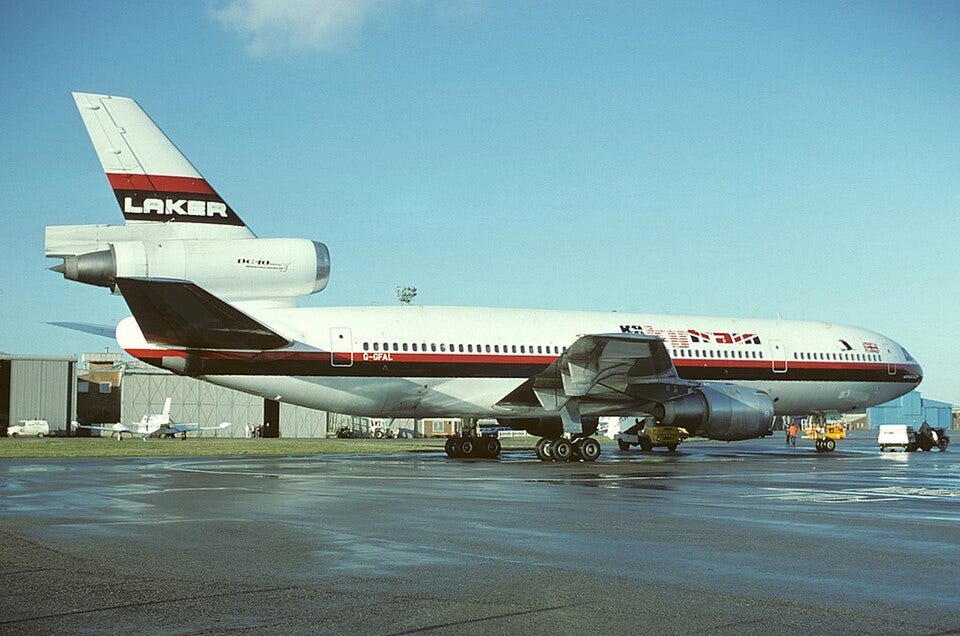
One of the most memorable airline figures I ever met was Freddie (later, Sir Freddie) Laker. He was an icon. A visionary. Ebullient, gregarious, and relentlessly charming, he was a technicolor personality in an industry run at the time by gray men in bespoke three-piece suits who treated air travel like an aristocratic diplomatic service.
Today, Silicon Valley and aviation analysts love to throw around the word “disrupter.” We talk about Herb Kelleher’s Southwest, the bare-knuckle ultra-low-cost playbook of Spirit, or Michael O’Leary’s Ryanair. But long before any of them made budget aviation an institutional science, Freddie Laker invented it from scratch. And unlike modern carriers who fight in open markets, Laker went to war against entrenched, government-backed cartels whose explicit mandate was to protect the status quo.
The Gilded Cage of 1970s Aviation
To understand the audacity of Freddie Laker, you first have to understand the absurd, cloistered world of commercial aviation in the early 1970s.
Every major international route was governed with an iron fist. The big players—BOAC (later British Airways), Pan Am, TWA, Lufthansa, and Air France—were called “flag carriers” for a reason: they carried the sovereign prestige (and often the sovereign checkbooks) of their home nations. Fares were not determined by supply, demand, or operational efficiency; they were fixed behind closed doors by the International Air Transport Association (IATA) and rubber-stamped by state agencies like the UK Civil Aviation Authority and the US Civil Aeronautics Board (CAB).
The cartel regulated everything. Ticket rules, cancellation fees, baggage allowances, and flight frequencies were identical across the board. In the late 1950s, IATA actually held an infamous, days-long multi-nation summit known as the “Great Sandwich War of 1958” to legally dictate what constituted an economy class meal—going so far as to rule that Scandinavian Airlines (SAS) was cheating the cartel by serving open-faced roast beef and smoked salmon smørrebrød with a fork, which the board ruled was a disguised luxury. Economy passengers, by bureaucratic decree, were strictly entitled to bread with simple cold cuts.
Crossing the North Atlantic back then was an extravagance reserved for corporate executives on expense accounts, diplomats, and the wealthy elite. An economy return ticket between London and New York routinely cost over £200—equivalent to several months of disposable income for a working-class Briton. If you didn’t have the money, you stayed on your side of the ocean.
Whenever anyone suggested opening routes to free-market competition, the legacy carriers offered two classic defenses: “We’ve always done it this way,” and “Unchecked price competition will destroy the dignity and safety of commercial flight.”
Then came Freddie.
A Rebel with a Wrench
Freddie Laker wasn’t born into boardrooms. Raised in Canterbury by a single mother who worked as a scrap-metal merchant, he started out sweeping aircraft hangars and working as a flight mechanic during the Second World War.
He made his first real fortune during the 1948 Berlin Airlift. When the Soviet Union blockaded West Berlin, cut off all land corridors, and threatened two million civilians with starvation, Laker bought a handful of surplus military cargo planes, hired daring pilots, and flew hundreds of round-the-clock supply missions hauling coal and flour into the besieged city. It was dangerous, chaotic, and intensely practical flying. It taught Freddie two lessons he never forgot: planes only make money when they are in the air, and aviation at its core is a logistical transport machine, not a royal court.
By 1966, he founded Laker Airways, running reliable charter operations with second-hand Bristol Britannias and BAC One-Elevens. But Freddie had his eyes on the holy grail: scheduled transatlantic travel for everyday people.
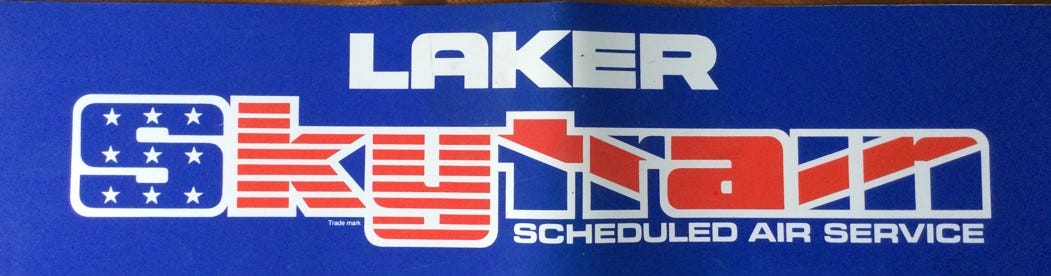
In 1971, he dropped a bomb on the aviation establishment. He announced Skytrain—a daily, nonstop, scheduled service between London Gatwick and New York’s JFK for a flat fare of £32.50 one-way (eventually rising to £59 (US$99) by the time it launched).
To use today’s vernacular, the incumbent carriers—British Airways, TWA, and Pan Am—had an absolute cow.
The Six-Year Trench Warfare
The legacy airlines knew that if passengers realized they could fly across the ocean for the price of a modest weekend coat, their artificially inflated fare structures would collapse.
They mobilized their friends in high places. For six grueling years, regulators on both sides of the Atlantic tied Laker up in regulatory hearings, procedural reviews, and courtroom battles. When the UK government revoked his license in 1975 under pressure from British Airways, Freddie refused to roll over. He mortgaged his personal assets, hired top barristers, and took the British government to the High Court—and won a historic ruling declaring that the Department of Trade had acted unlawfully.
When American regulators at the CAB dragged their feet on issuing his foreign air carrier permit, Freddie turned to the court of public opinion. He flew to Washington, appeared on US television, gave fiery press conferences, and charmed the public with his blunt, working-class charisma:
“The cartel airlines are flying whole planeloads of fresh air across the Atlantic every day,” Freddie boomed. “I want to put people in those seats.”
President Jimmy Carter, an advocate for airline deregulation, finally signed the executive order authorizing Skytrain in June 1977. Freddie had won the right to fly.
£59 and a Walk-Up Ticket
When Skytrain officially took wing on September 26, 1977, Freddie applied the purest version of the KISS method (Keep It Simple, Stupid).
There were no expensive city-center ticket offices, no massive computerized reservation databases, and no 10% commissions paid to high-street travel agencies. You didn’t book weeks in advance. Instead, you packed your bags, showed up at the terminal on the morning you wanted to fly, handed over cash at the sales counter, got your ticket, and walked onto the aircraft.
Every single one of the 345 seats on his widebody McDonnell Douglas DC-10 was sold at the exact same price.
Traditionalists scoffed that people wouldn’t stand in line for long-haul travel. They were dead wrong. The night before the inaugural flight, hundreds of young travelers, students, families, and backpackers began camping out on the polished concrete floors of London Gatwick, sleeping bags unfurled, waiting for the ticket desk to open at dawn.
Freddie didn’t stay in an executive suite. On launch morning, he showed up at Gatwick in his overcoat, walked the line shaking hands, handed out cups of tea from a drinks trolley, and thanked passengers individually for helping him break the cartel.
Woodstock at 35,000 Feet
I was on one of those early Gatwick-to-JFK flights, and the best way to describe the atmosphere was an absolute party in the sky.
It was the most eclectic passenger manifest ever assembled. There were scruffy university students with tie-dyed T-shirts sitting alongside respectable, tweedy English couples who looked as if they had just stepped off the cover of Country Life. There were young American backpackers returning home, blue-collar workers visiting family in the States for the very first time in their lives, and budget-conscious businessmen quietly marveling at their savings.
Because food wasn’t rolled into the ticket price, the cabin turned into a communal picnic. Some bought the £1 hot meal packs on board, but half the cabin brought their own provisions: greasy wax-paper bags of fish and chips, Tupperware containers packed with ham sandwiches, cold roast chicken, and tins of shortbread.
Somewhere over the Irish Sea, the cabin vibe shifted into something unforgettable. A trio of travelers unpacked acoustic guitars and a pair of bongo drums in the rear cabin and kicked off an impromptu concert. Before long, half the economy section was singing along, clapping, sharing snacks across the aisle, and cheering as the flight attendants rolled down the aisles selling £0.30 miniature bottles of gin.
I’ve crossed the Atlantic a couple of hundred times on United, BA and American and honestly cannot remember anything special about any of them. But every time I think back to that Skytrain flight, I realize I am grinning.
For $99, I thought the seat, the camaraderie, and the unpretentious joy of the journey made it the best deal in the history of commercial flight.
Keep reading with a paid subscription to Stories from Seat 4A from only $5 a month with an annual subscription for the best stories in the aviation industry
