
The A380: A Monument to the Wrong Future?
Happy 21st Birthday to the World’s Largest Airliner

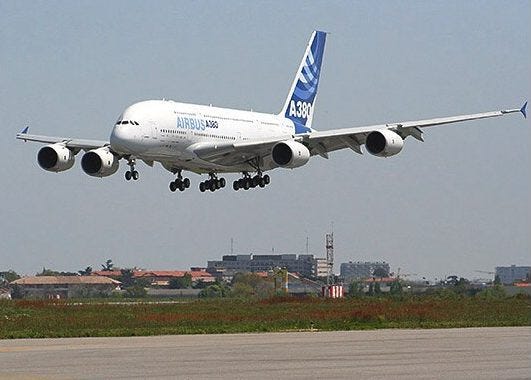
On April 27, 2005, a crowd of thousands gathered on the tarmac at Toulouse-Blagnac to watch something that had never existed before lift into the sky. At 10:29 AM the Airbus A380 — 555 seats, four engines, a wingspan wider than a football field — climbed slowly, almost majestically, as if the air itself needed a moment to adjust. One engineer who watched it that morning said it was like watching a cathedral take flight.
Twenty-one years later, that cathedral stands as one of commercial aviation’s most instructive monuments: magnificent, beloved, and a $25 billion lesson in the perils of betting on a world that never quite arrived.
Two Manufacturers, One Crossroads
The story begins with a genuine intellectual disagreement between the two great aircraft manufacturers of our era. At the turn of the millennium, Boeing and Airbus looked at the same congested global hubs and reached opposite conclusions. Boeing argued that passengers were exhausted by the hub-and-spoke grind — the trudge through Heathrow, the missed connection at JFK — and that new engine technology would soon allow smaller, efficient twin-jets to connect secondary cities non-stop.
Their answer was the 787 Dreamliner.
Airbus looked at the same airports and saw a ceiling, not a bottleneck. If Heathrow is running at 98% capacity and no new slots are coming, the only way to grow is to make each departure carry more people. It wanted to go beyond the Boeing 747 and develop the first commercial Very Large Aircraft (VLA).
Its answer was the A380, and Airbus predicted a global market for 1,200 to 1,500 such aircraft over the next 20 years.
The A380 was engineered to do exactly that — to “de-congest” the world’s most constrained hubs by moving 500-plus passengers in a single take-off slot.
Both arguments were rational. Airbus simply turned out to be wrong about which problem needed solving.
At the turn of the millennium, Airbus launched the A380 with a projected development cost of roughly $10 billion, claiming a breakeven point of just 250 to 270 aircraft. However, the program soon collided with the brutal "arithmetic" of reality. By the time the production line closed, the investment had ballooned to an estimated $25 billion, effectively doubling the breakeven target to more than 500 units. In a poignant historical irony, the program ended with only 251 aircraft ever built—landing almost exactly on the original, optimistic target while failing to meet the final, insurmountable financial requirement.
The Finest Cabin Ever to Leave the Ground
Where the A380 won without contest was in the cabin. It remains, arguably, the finest passenger experience ever offered at scale in commercial aviation.
The acoustic environment was library-quiet — a consequence of sheer mass absorbing vibration that smaller jets simply cannot. Emirates fitted upper-deck shower spas and a cocktail bar.
Premium Economy passengers on Singapore Airlines found more legroom than they’d experienced in business class on rival carriers.
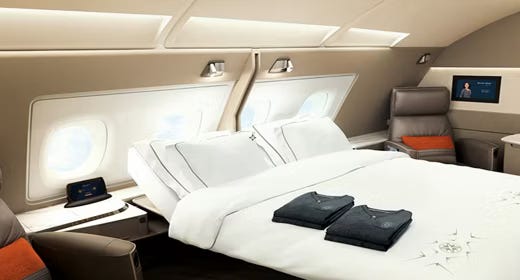
Passengers didn’t merely fly on the A380; they sought it out, specifically requesting the aircraft when booking. By any measure of what aviation is supposed to feel like, the superjumbo won.
The Spreadsheet Always Wins
But the airline business runs on spreadsheets, not sentiment.
The A380’s fatal vulnerability was arithmetic. Profitability required filling close to 400 seats on every single leg. Fly 300 passengers and you are burning fuel for 200 empty seats, while a 787 carrying those same 300 people turns a handsome margin.
Airbus offered a freighter version, the A380F, and later more efficient passenger variants: the A380-900 stretch, the A380neo, and the A380plus, but none of these ever became a reality.
As twin-engine technology advanced through the 2010s — the A350, the 777X — the four-engine economics that once defined long-haul flying became not merely inefficient but indefensible. Airbus closed the order book in 2019. Only 251 aircraft were ever built.
The fragility of the model was exposed brutally when the world went wrong.
During the 2020 pandemic, A380s were the first aircraft parked in the desert, their sheer size making them impossible to redeploy as demand shifted and collapsed. Some carriers, such as Air France, China Southern, Malaysia Airlines, and Thai Airways never operated the A380 again.
And now, in the spring of 2026, the same story is playing out again. The 2026 Iran war — and with it the closure of the Strait of Hormuz — has shattered Gulf route economics overnight. The great Gulf hub carriers that built their networks around the A380 are once again looking at their fleets and asking which aircraft can pivot, and which cannot. A 787 can be redeployed to a different continent within days.
An A380 needs the infrastructure, the gates, the ground crews, and above all the guaranteed passenger flood that only a handful of routes in the world can reliably provide.
Who Still Flies the Superjumbo?
As of April 2026, roughly 190 A380s remain in active service across just ten operators — a remarkably small club for a type that was once supposed to reshape global aviation.
Emirates dominates the picture almost comically, operating somewhere between 116 aircraft, which means a single airline accounts for well over half the world’s active superjumbo fleet.
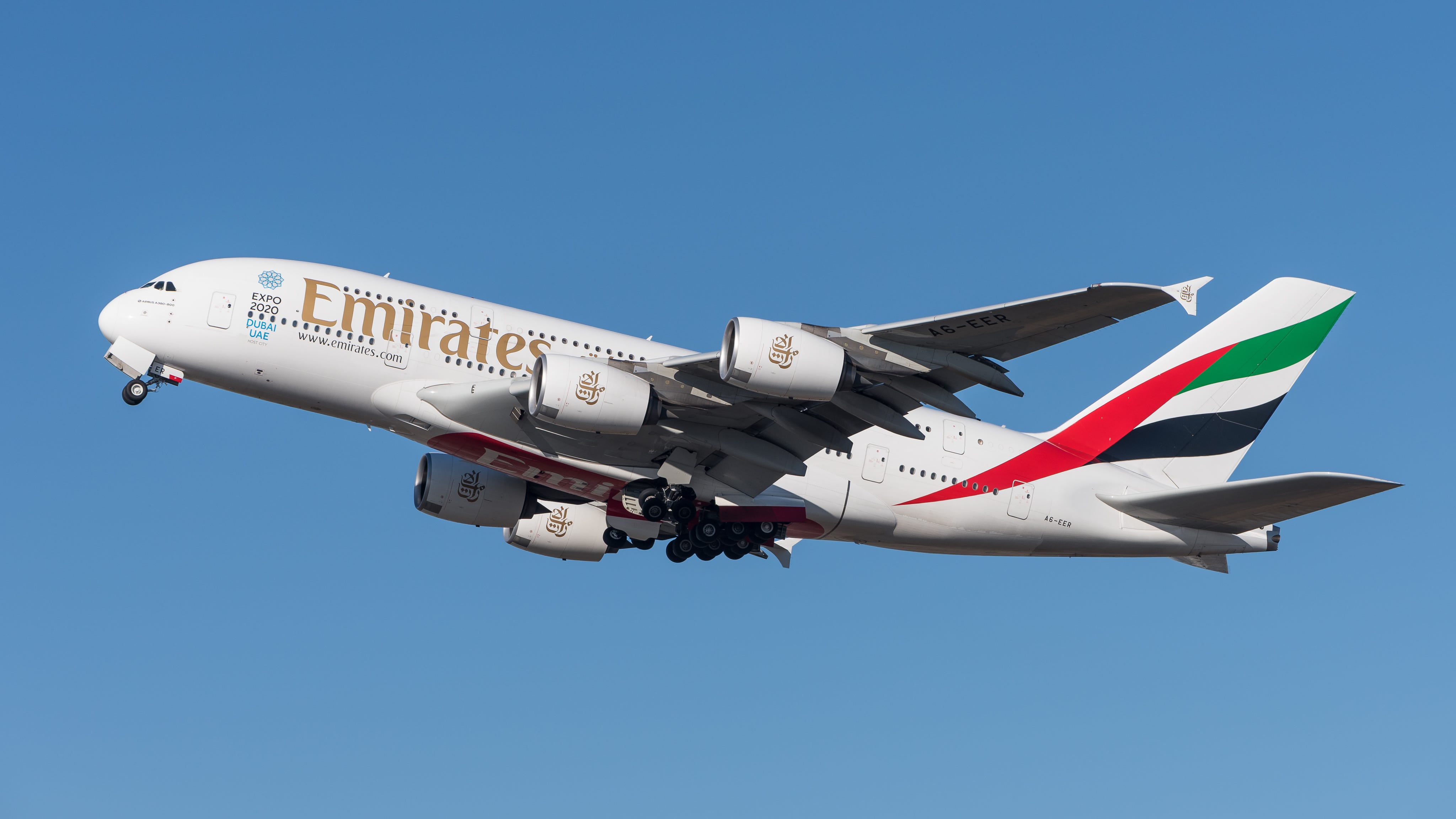
After Dubai, the numbers fall away sharply: British Airways and Singapore Airlines operate 12 each, Other operators include Qantas (10), Etihad (9), Qatar Airways and Lufthansa (8 each), Korean Air and Asiana (6 each), and All Nippon Airways with three. For an aircraft that was going to revolutionize mass air travel, it ended up as a niche instrument — magnificent in the right hands, on the right routes, with the right economics behind it.
The Verdict
Airbus was not wrong about congestion. Heathrow remains as slot-constrained as it was in 2005. Hong Kong, Tokyo, Singapore — the busiest nodes in the global network are as choked as ever. What Airbus misjudged when it predicted a need for 1,200 to 1,500 VLAs was the solution. The industry found a way around congestion by distributing demand across thinner routes rather than concentrating it into ever-larger aircraft.
While the 380 is a delight to fly (both for passengers and pilots), it was a financial disaster for Airbus.
Today, the A380 flies on in the hands of those ten carriers, and for their passengers, it remains an experience without parallel at 35,000 feet.
But for the industry as a whole, the superjumbo endures as a beautiful, cautionary monument — proof that in airline strategy, the question is never simply how big can we build. The question is always how flexible can we stay.
Did you ever fly the A380? Tell us your best A380 memory in the comments — and while you're there, weigh in on the bigger question: will commercial aviation ever again see a Very Large Aircraft of this scale, or is the A380 the last of its kind?