
2 May 1952: The Day the Jet Age Began

The passengers waiting at London Airport on the morning of May 2, 1952, had no particular reason to believe this day was different from any other. The women wore pillbox hats and wool coats against the spring chill; the men carried briefcases and the quiet confidence of people accustomed to flying.
They had crossed oceans before, after all — rattling through turbulent air in lumbering propeller-driven Constellations and DC-4s, pressing cotton wool into their ears against the ceaseless drone of reciprocating engines, watching the altimeter stay stubbornly low where the weather was rough and the ride was rougher.
What they were about to board was something else entirely.
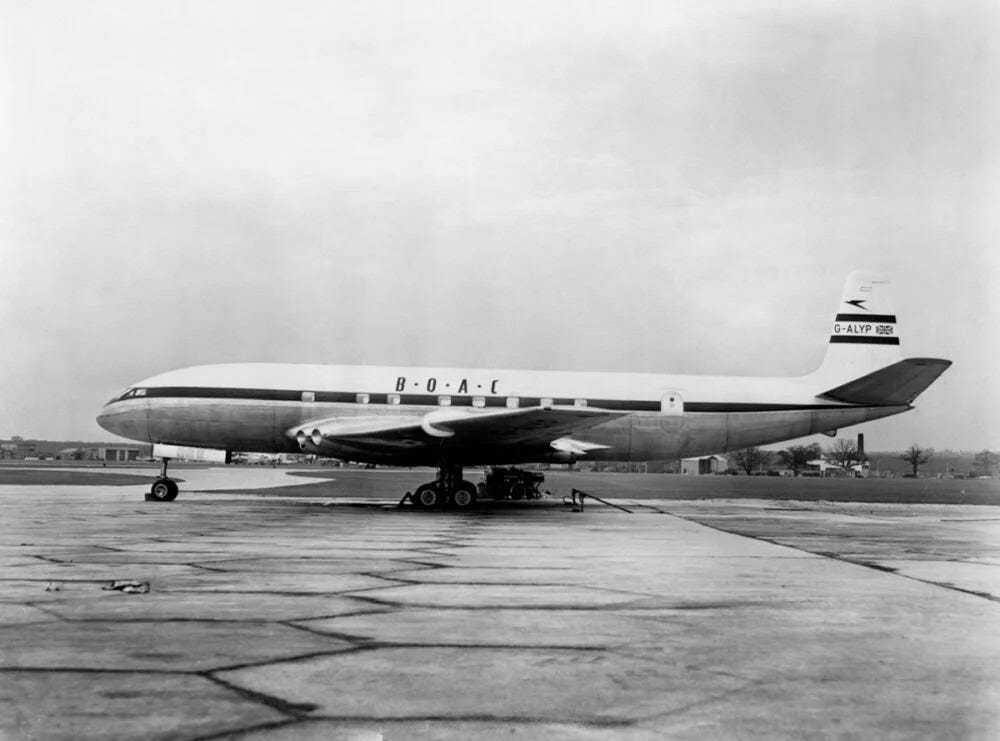
The de Havilland Comet gleamed on the apron — slim, silver-white, almost impossibly elegant for something that weighed thirty tons. Four jet engines were buried cleanly in its wings, with none of the ungainly nacelles that cluttered every other airliner on the ramp. Its windows were large and squarish, almost generous, as if the designer had wanted passengers to see the world differently. As indeed they would.
When the Comet’s four turbines spooled up that morning, the sound was unlike anything those passengers had ever heard from a commercial aircraft — a rising, continuous keening rather than the familiar mechanical clatter. Then the brakes released and G-ALYP, the flagship of the British Overseas Airways Corporation, began to roll.
Their destination was Johannesburg, 6,724 miles to the south, with stops in Rome, Beirut, Khartoum, Entebbe, and Livingstone.
And with that takeoff roll, the passenger jet age began.
The Audacity of de Havilland
The Comet had been a leap of faith, conceived in the wreckage of World War Two by a British aircraft industry that was simultaneously exhausted and consumed with ambition. De Havilland’s design team had looked at the same turbine engines that powered the Meteor and the Vampire and asked a different question: not how fast can this fly, but how smoothly can 36 passengers reach Johannesburg?
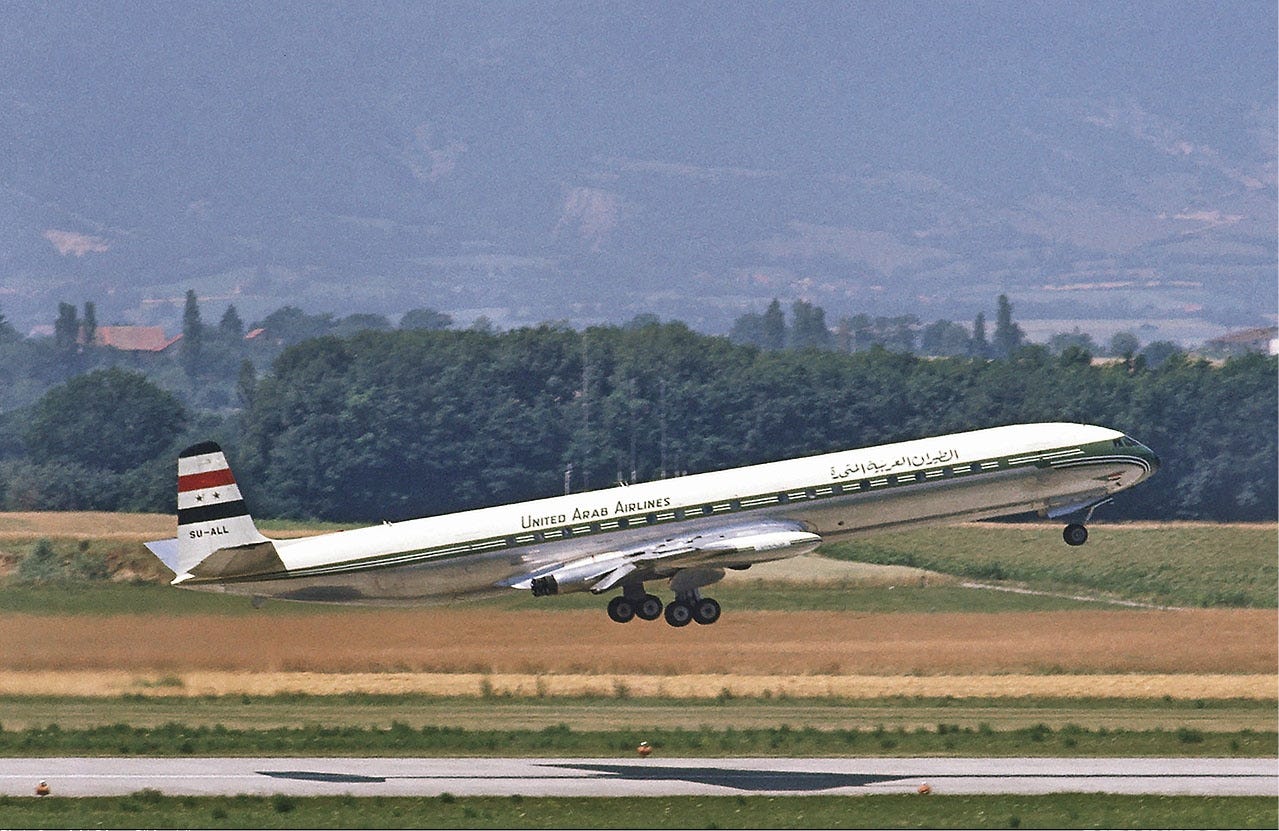
The answers they arrived at were extraordinary. The Comet cruised at around 450 mph — more than fifty percent faster than any piston airliner — at altitudes up to 36,000 feet, skimming above the weather that made lower-altitude flight such a misery.
The pressurized cabin was hushed and serene. Passengers sipped drinks that didn’t rattle. They looked down through those large windows at clouds rather than up at them.
The prototype had flown in 1949. Three years of refinement later, the Comet entered revenue service, and the world took notice. In its first twelve months, BOAC’s Comets carried more than 30,000 passengers.
By mid-1953, eight Comet flights were departing London each week — to Johannesburg, Tokyo, Singapore, Colombo. Industry analysts quietly concluded that Britain had opened a lead of three to five years over everyone else in the world. The Americans, the French, the Soviets — all of them were still drawing on graph paper what de Havilland had already flown.
For a nation still living on rationing and rebuilding its bombed cities, there was something almost defiant about it. Britain had put the future in the air.
The Sky Gives Nothing Away
Then the sky collected its debt.
Between 1952 and 1954, a succession of Comets simply ceased to exist. The most chilling episodes were over the Mediterranean — aircraft that departed normally, climbed to cruising altitude, and then, with no distress call and no warning, broke apart. Wreckage was found in the sea. No explanation that ordinary aerodynamics could supply.
What followed was one of the most painstaking forensic investigations in the history of aviation. British engineers constructed an enormous water tank, submerged an entire Comet fuselage inside it, and then pressurized and depressurized it over and over and over — simulating thousands of flights in a matter of months. They were looking for a crack, and eventually they found many.
The culprit was metal fatigue, and it concentrated with lethal precision around the Comet’s square windows and the hundreds of small penetrations in the fuselage skin where wiring and antennas passed through.
Every time the aircraft climbed and the fuselage pressurized, every time it descended and depressurized, those corners and edges experienced stress concentrations that no designer in 1946 had the tools — or the precedent — to fully calculate. Microscopic cracks formed. They grew. They linked. And at altitude, at 500 mph, the rest happened in an instant.
The lessons were savage but permanent. Rounder window corners became non-negotiable. Fatigue testing protocols were standardized across the entire industry. Stress analysis methodology was transformed. Every jetliner built since — every Boeing, every Airbus, every aircraft that has ever carried you safely above the weather — was made stronger by what the Comet taught the world at the cost of its reputation and its passengers’ lives.
When Britain Led the World
By 1958, de Havilland had redesigned the Comet from the skin outward, and the Comet 4 entered service with BOAC that October. In a moment of genuine drama, a BOAC Comet 4 inaugurated the world’s first transatlantic commercial jet service — beating Pan American’s Boeing 707 across the Atlantic by three weeks. For one brief, glorious fortnight, Britain led the world again.
Then the 707 arrived in commercial service, and the arithmetic became merciless. The Boeing was bigger, its range was longer, its operating costs were lower, and Douglas Aircraft was already rolling out the DC-8 to compete for the same orders.
The American industry didn’t just catch up; it overwhelmed. By the 1980s, Boeing alone held more than half the world’s orders for large commercial jets. The Comet, even in its improved form, was a footnote in a chapter the Americans had largely written.
France watched this unfolding with particular alarm. So did Germany, and eventually Britain itself. No single European nation could match the scale of Boeing or McDonnell Douglas — not in capital, not in production capacity, not in the depth of the domestic market that sustained American manufacturers through the lean years.
And so, in the late 1960s, an idea that would once have seemed politically impossible took shape: France, Germany, the United Kingdom, and later Spain would pool their engineering talent, their government backing, and their pride into a single consortium. Airbus Industries was born from the recognition that Europe’s choice was cooperation or irrelevance.
The modern Airbus-Boeing duopoly — the architecture of virtually every commercial flight you will take in your lifetime — traces its lineage, in a direct line, back to that morning at London Airport when G-ALYP lifted its nose toward Johannesburg.
What the Comet Left Behind
Aviation history tends to consecrate the victors: the 707, the 747, the A380. The Comet is remembered, if at all, mainly for what went wrong. That is a misreading of what it actually was.
Before the Comet, flying long-haul meant enduring hours of vibrating, droning, below-the-weather slog that left passengers crumpled and exhausted on arrival. The Comet introduced an entirely different proposition: that air travel could be smooth and swift and even elegant — that the journey might be, against all previous evidence, something to enjoy rather than simply survive.
It planted that idea in the mind of every passenger who ever flew on it. And when those passengers came home and described what it was like to sit in a quiet cabin above the clouds, drinking a gin and tonic and looking down at the Mediterranean from 36,000 feet, the idea spread.
The jet age wasn’t only a technological phenomenon. It was a shift in human expectation — a collective decision, made by millions of ordinary travelers, that the sky was no longer a frontier to be endured but a highway to be used.
The Comet built that highway. It paid for it in tragedy. And seventy-three years later, every time you lean back in your seat and feel the wheels leave the tarmac, you are traveling on a road that a slim, silver-white aircraft first opened on a spring morning in 1952.
Some of my earliest airline career memories were of flying Dan-Air’s Comet 4s. Did you ever fly the Comet — or does someone in your family carry that memory? I’d love to hear it.